|
 |
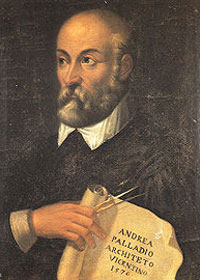
Andrea di Pietro della Gondola Romania was born in Padua in 1508; he was reborn three decades later as ‘Andrea Palladio,’ but he was not called ‘architect’ until he was nearly forty. Rising from the ranks of stonecutting, Palladio shared little with his architectural contemporaries: he was not famous prior to his architectural commissions, he was not part of an artistic guild, and he was not a product of Florentine or Roman apprenticeship. Nonetheless, Palladio became one of the most influential architects in history. He was self-educated, had a voracious appetite for reading, and unlike many Renaissance architects, he spoke the language of construction. As a student of Rome, his surveys of ruins were instrumental to his adaptive usage of classical proportions and forms. Palladio bridged the gap between theoretician and builder. His treatise I Quattro Libri dell’Architecttura was approachable to non-academics since it was written in Italian, rather than erudite Latin, and co ntained clear line drawings with dimensions. Palladio’s unprecedented focus on domestic architecture redefined the Veneto and translations of the Quatto Librari ultimately inspired global experimentations in Palladian principles. |
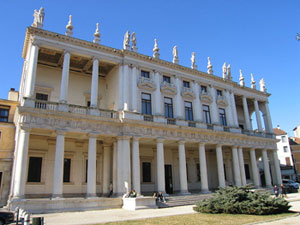
Palladio’s façade of Palazzo Chiericati in Vicenza |
|
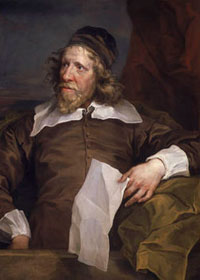
In England, at the age of forty, cloth maker-turned-joiner-turned painter Inigo Jones added architecture to his list of creative explorations when he discovered Palladio’s works while in Italy. Jones was immediately smitten. He introduced Palladio to England, albeit in a more restrained, solid manner characterized by the use of stone, a material often foreign to Palladio’s budget. Jones translated the vivid frescoes that enlivened Palladio’s interiors into physical architecture: the trompe de l’oeil was traded for the tactile. Jones even collected Palladio’s rich drawings. |
|
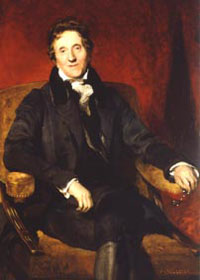
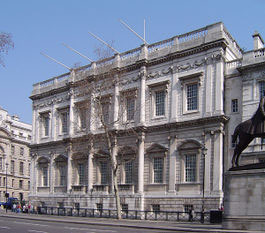
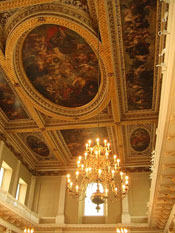
At the end of his life, Soane worked on the restoration of the Banqueting House. This Jones design, site of the October 2010 Sir John Soane’s Museum celebration dinner, inspired a drawing that won Soane a Royal Academy Silver Medal. The drawing was a stepping stone towards the Gold Medal and eventually the Traveling Scholarship that sponsored Soane’s Italian tour. Because of Jones, Soane ‘met’ Palladio. While in Italy, Soane studied the ruins of Rome but also used Palladio’s Veneto as an architectural classroom. Multiple copies of the Quattro Libri were in Soane’s library, one from his patron the Bishop of Derry.
The above piece appears in the Soane Foundation Spring 2010 newsletter. Author: Danielle S. Willkens, Associate AIA, FRSA, is a graduate of the University of Virginia (2008); Sir John Soane’s Museum Foundation Traveling Fellowship Award (2007); Cambridge University St. John’s College, M.Phil (2006), University of Virginia, BS |
 |
|
Presented by the Royal Institute of British Architects in association with the Centro Internazionale di Studi di Architettura Andrea Palladio and the Morgan Library and Museum, which is on view at The Morgan, 225 Madison Avenue at 36th Street.
The exhibition is made possible by the generous support of the Regione del Veneto, Dainese, Richard H. Driehaus Charitable Lead Trust, British Architectural Library Trust, Gladys Krieble Delmas Foundation, Samuel H. Kress Foundation, Center for Palladian Studies in America, Richard Wernham and Julia West, Andrew D Stone, William T. Kemper Foundation, Anne Kriken and Sir John Soane's Museum Foundation.This exhibition will then travel to Washington, DC, Pittsburgh and Milwaukee.
at The Morgan Library & Museum
JAQUELIN T. ROBERTSON, FAIA, FAICP of Cooper, Robertson & Partners, has devoted a long and distinguished career to architecture, urban design, education and public service; to retaining "human and local values" in both the design of the city and in regional architecture. His avid engagement with the ideas and issues of his time ranges from his early roles in the Lindsay Administration - founder of the New York City Urban Design Group, first Director of The Office of Midtown Planning and Development, a New York City Planning Commissioner - to his eight years as Dean of the School of Architecture and Commonwealth Professor at the University of Virginia.
Robertson's abiding interest in Palladio started in Virginia, many of whose best buildings are Georgian Palladian. This early exposure was strengthened over the years by a growing interest in Thomas Jefferson and his works - Monticello, The Academical Village at the University of Virginia, Popular Forrest and various small villas and additions. Moreover, Robertson grew up in one of William L. Bottomley's best Georgian Palladian houses; that is Palladio was "in the air" from the start.
Jefferson famously referred to Palladio as "the Bible"; a view clearly held by Robertson who proclaims flatly, "Palladio if not the best is surely the most influential Western architect. He discovered Rome and Greece and set out the "rules of play" for those who came after - in a way that changed the course of architecture in both Europe and America."
Tickets and reservations are free for Patron’s, Supporter’s and Friend’s of the Soane. Please inquire to rsvp@sirjohnsoanesmuseumfoundation.com | T. 212-223-2012
 “Discover Palladio” , New York Times Style Magazine 03-28-10 “Discover Palladio” , New York Times Style Magazine 03-28-10
|
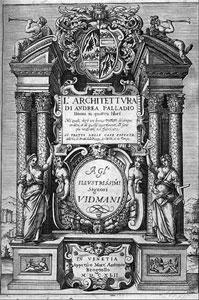
The front page of I Quattro Libri dell'Architettura (The Four Books of Architecture) |
,
Please consider joining Sir John Soane’s Museum Foundation for our annual gala dinner dance celebration entitled Bravo Palladio has been inspired by the legacy of Andrea Palladio. That evening will be the presentation of the Soane Foundation Honors to A. Eugene Kohn, Chairman and Founding Partner of Kohn Pedersen Fox, Susan Weber, Founder and Director of Bard Graduate Center: Decorative Arts, Design History, Material Culture and Yale University Press, with John Donatich, director, accepting.
For further details about the gala benefit, please visit our page or call 212-223-2012.
Seating is limited; Reservations for the Gala close on Tuesday, April 20.
,
Explore Palladio's enduring transatlantic legacy in this illustrated lecture with Charles Hind, H. J. Heinz Curator of Drawings, RIBA British Architectural Library, and Calder Loth, Senior Architectural Historian, Virginia Department of Historic Resources. Hind begins by tracing the journey of Palladio's drawings from Italy to England and the significant impact these drawings had on British architecture. Loth will then examine how Palladianism shaped the American architectural image beginning in the colonial period, through the works of Thomas Jefferson, and through the monumental architecture of the twentieth century. This program is cosponsored by the Sir John Soane's Museum Foundation.
Tickets: $15 for Non-Members; $10 for Morgan and Soane Foundation Members
*The exhibition Palladio and His Legacy: A Transatlantic Journey will be open at 5:30 pm especially for program attendees. Details and tickets, please to the
Other Palladio events… please check with for additional related programs |
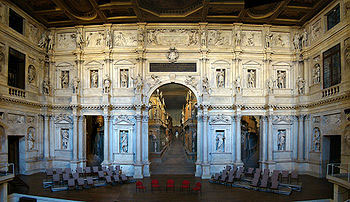 |
| Scaenae frons of the Teatro Olimpico. The large arch in the center is known as the porta regia or "royal arch". The Teatro Olimpico is a theatre in Vicenza, northern Italy: constructed in 1580-1585, it is the oldest surviving enclosed theatre in the world. The theatre was the final design by the Italian Renaissance architect Andrea Palladio and was not completed until after his death. The trompe-l'œil onstage scenery, designed by Vincenzo Scamozzi, to give the appearance of long streets receding to a distant horizon, was installed in 1585 for the very first performance held in the theatre, and is the oldest surviving stage set still in existence. |
|
|
|