RECENT PAST SERIES: 2007 SPRING SEMINARS
AIA/CES credits offered — 1.5 hours per session
Sir John Soane’s
Museum Foundation is pleased to continue providing specialized
educational programs in the United States for professionals
and the layperson alike to explore in-depth specific
issues of architecture, the arts, design, and interiors.
Our series qualify for professionals needing continuing
educational credits with AIA / CES.
Our program is presented in cooperation with the Yale Center for British Art.
|
| The Queen’s House has long been celebrated as the fount of the classical tradition in British architecture. Begun in 1616 for Queen Anne of Denmark as a pavilion straddling the road between the garden of Greenwich Palace and the royal hunting park, it was Inigo Jones’s first major royal building after his tour of Italy in 1613-14 and his earliest essay in the villa manner of Palladio and Scamozzi. But although Jones started by designing a Palladian villa, the building he finished for Charles I’s French queen, Henrietta Maria, in the 1640, after a break in construction following Anne’s death in 1619, is far removed in character from the Italian suburban or rural house. Most extraordinary of all is the 40-feet cube hall on the north side, facing the palace, with its beamed ceiling framing Orazio Gentileschi’s paintings of Peace and Arts under the English Crown. What was the purpose of this hall, and how did Jones intend the building to be entered and used? Following extensive research on the drawings and archaeology of the Queen’s House, Gordon Higgott will explain how Jones modified his original designs for the building in 1616 and adapted them later to satisfy the functional and artistic aspirations of Henrietta Maria. |
 |
 |
| click to view larger |
|
|
 |
 |
| First Design for the Queen's House, 1616 |
Queen's House, south facade |
| click to view larger |
click to view larger |
|
 |
 |
 |
| Queen's House, Cube Hall |
Queen's House, Bedchamber |
Queen's House, Spiral Stairs |
| click to view larger |
click to view larger |
click to view larger |
|
Session 2 –
Wednesday, 14 March 2007 - 6:30 p.m.
|
| By the early 1630s Inigo Jones, as Surveyor of the Royal Works, had perfected the design of scenic stage at the court of Charles I in London, and built a theatre for Shakespearian drama in the octagon of the old Tudor cockpit at Whitehall palace. Jones was inspired by Palladio’s Teatro Olimpico in Vicenza, by Italian court spectacle, and by the ancient Roman theatres described by Vitruvius. But how much of Jones’s innovative work found its way to the private indoor playhouses of the 1630s, and what effect did it have on the scenic playhouse in London after the Restoration? Drawings by Jones’s assistant John Webb – drawings previously been attributed to Jones himself – show him developing a Palladian-style theatre for scenic and auditory drama before and after the Restoration in 1660. However, Webb’s efforts were rapidly overtaken by the work of Sir Christopher Wren (1632-1723). His technical virtuosity in the design of the Sheldonian Theatre at Oxford (1663-69) and his first-hand knowledge of Louis XIV’s Salle des Machines in Paris, informed his brilliant solution for the design of the new Theatre Royal in Drury Lane (1673-74), a building which became a model for the London scenic playhouse over the new two centuries. |
 |
 |
 |
 |
| Jones's stage design for the Whitehall Cockpit, 1639 |
John Webb's design for a Palladian stage, c. 1630 |
John Webb's design for a playhouse, c. 1660 |
Wren's design for the Theatre Royal, 1673-1674 |
| click to view larger |
click to view larger |
click to view larger |
click to view larger |
|
 |
 |
 |
| Wren's Sheldonian Theatre, 1663-1669 |
Interior of Sheldonian Theatre |
Sir Christopher Wren |
| click to view larger |
click to view larger |
click to view larger |
Our program is presented in cooperation with the Yale Center for British Art.
|
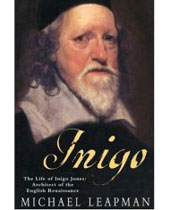
Inigo Jones (July 15, 1573 – June
21, 1652) is regarded as the first significant English
architect. He also made valuable contributions to
stage design.
Beyond the fact that he was born
in the vicinity of Smithfield in central London, the
son of a Welsh Catholic clothworker, and christened
at the church of St Bartholomew the Less, little is
known about Jones' early years. But towards the end
of the 16th century, he became one of the first Englishmen
to study architecture in Italy, making two visits
to that country.
Jones' best known buildings are
the Queen's House at Greenwich, London
(started in 1616, his earliest surviving work - pictured
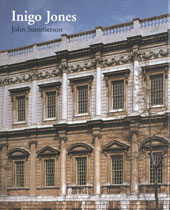
right) and the Banqueting
House at Whitehall (1619 -- see below) -- part
of a major modernisation by him of the Palace of Whitehall
-- which also has a ceiling painted by Peter Paul
Rubens. The Banqueting House was one of several projects
where Jones worked with his personal assistant and
son-in-law John Webb. |

Portrait by Sir Anthony van Dyck |
The other project in which Jones
was involved was the design of Covent Garden. He was
commissioned by the Earl of Bedford to build a residential
square along the lines of an Italian piazza. The Earl
felt obliged to provide a church and he warned Jones
that he wanted to economise. He told him to simply
erect a "barn" and Jones' oft-quoted response
was that his lordship would have "the finest
barn in Europe". Little remains of the original
church situated to the west of the piazza.
As the Surveyor to King Charles
I, Jones worked for Queen Henrietta Maria on the design
of a Roman Catholic chapel at Somerset House (an act
that provoked great suspicion from the Protestants)
and his career effectively ended with the outbreak
of the English Civil War in 1642 and the seizure of
the King's houses in 1643. His property was later
returned to him (c.1646) but Jones ended his days
living in Somerset House and was subsequently buried
in the Church of St Benet Paul's Wharf, in London.
John Denham and then Christopher Wren followed him
as King's Surveyor. |
Soane and Jones
Sir John Soane (1753 – 1837)
referred warmly to Inigo Jones's architecture in his
lectures as Professor of Architecture at the Royal
Academy, remarking on Jones’s ‘superior
knowledge in architecture’. His connection with
Jones began as a nineteen year old student, when Soane
used the opportunity given by scaffolding on the Banqueting
House for its repair in 1773 to measure the facade
and produce a drawing which won for him the Royal
Academy Silver medal (which still hangs in the Breakfast
Room of No.12 in the Museum). He could not have dreamt
then, that he would be the architect chosen for its
restoration over half a century later in 1829-33.
The project involved restoring and largely re-facing
the façade - and acquiring for his Museum,
during the process, one of the original, much decayed
pilaster capitals. Also on display in the Museum’s
Model Gallery is a 3D analysis of the original Jones’s
roof of the Banqueting House – probably commissioned
by Soane, like many of his architectural models, for
a combination of professional and instructional uses.
The original roof was also replaced by Soane. The
Museum also owns the original notebook belonging to
Nicholas Stone – the sculptor and master craftsman
who worked alongside Jones on the Banqueting House
and other major commissions – a rare and revealing
document for all Inigo Jones scholars. |
|
Sir John Soane's Museum Foundation
1040 First Avenue, No. 311
New York, NY 10022 USA
T . 212-223-2012
Info@SoaneFoundation.com
www.SoaneFoundation.com |
|